The Fortress vs The Agora - Where Should Developing Economies Compete?
Feb. 4, 2026 | By Billy Wong

For university leaders in emerging research economies, the global academic landscape often feels like a walled garden. The most famous journals seem impenetrable, dominated by a tight circle of Western institutions.
Is this perception true? And if so, where are the cracks in the wall?
Our analysis of the dataset of 2026 Journals 100 applies a strategic lens to this problem. By plotting Gravitas (Prestige) against Diversity of authoring institutions (Global Participation), we can map the entire publishing landscape into four distinct quadrants.
Understanding where a journal sits on this matrix is critical for optimizing your university's submission strategy.
The 2x2 Matrix: The Four Worlds of Publishing
We define the two axes as:
- Vertical Axis (Gravitas): The journal's power to define the field, as measured by Network Centrality.
- Horizontal Axis (Diversity of authoring institutions): The breadth of institutions that successfully publish there, as measured by Entropy.
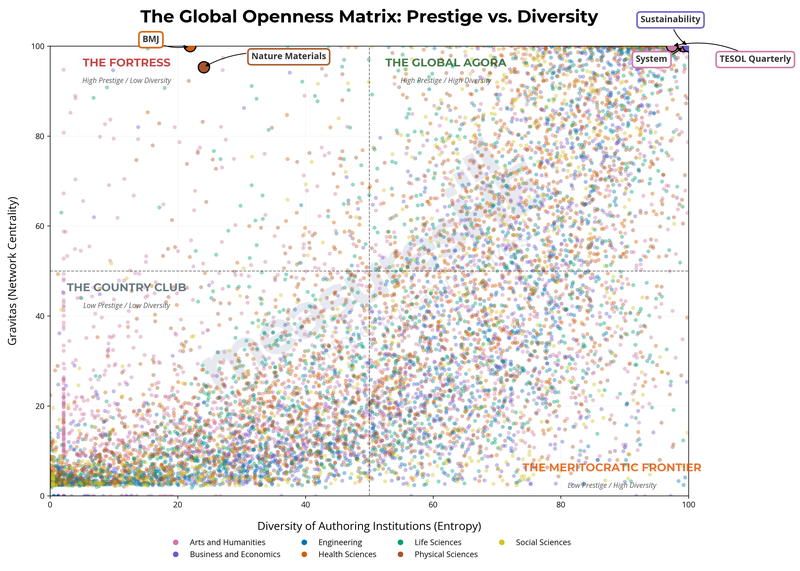
1. The Fortress (Top Left)
- Profile: High Prestige, Low Diversity.
- Examples: BMJ (Health), Nature Materials (Physical Sciences), Chemical Reviews.
- The Dynamic: These are the "Old Boys' Clubs" of academia. They are hyper-central to the conversation but rely on a relatively small, concentrated circle of contributing institutions.
- Strategy: "Snipe with Care." Do not flood these journals with volume. Target them only with your absolute best, world-class work, preferably with a co-author from inside the "club" (a top Western institution) to unlock the door.
2. The Global Agora (Top Right)
- Profile: High Prestige, High Diversity.
- Examples: TESOL Quarterly, System, Journal of Human Evolution.
- The Dynamic: These are the "Open Elites." They are just as prestigious as the Fortresses, but their authorship is truly global. They judge based on merit, not postcode. Interestingly, Arts & Humanities journals dominate this quadrant, proving to be the most democratic global conversations.
- Strategy: "Prioritize Heavy Investment." These are your highest ROI targets. They offer the double win of high prestige (Gravitas) and an open playing field for authors from developing economies.
3. The Country Club (Bottom Left)
- Profile: Low Prestige, Low Diversity.
- The Dynamic: Niche journals dominated by a specific region or small clique of universities, without global influence.
- Strategy: "Avoid." These venues offer low return on effort. They are hard to get into (due to cliquishness) and offer little reward (low Gravitas).
4. The Meritocratic Frontier (Bottom Right)
- Profile: Low Prestige, High Diversity.
- The Dynamic: Newer, high-volume, or interdisciplinary journals that welcome the world but haven't yet cemented their central status.
- Strategy: "Build the Future." Use these for volume and training. They are easy to access and help build your researchers' confidence and citation count (FWCI), even if they don't yet bring institutional prestige.
Sector Analysis: Who is building Walls?
When we aggregate this data by Subject Domain, the structural biases of science become clear.
- Most Closed (The Walls): Health Sciences (Avg Diversity ~45.6) and Life Sciences (~45.8). The medical field remains the most "gatekept" sector of academia.
- Most Open (The Bridges): Arts and Humanities (Avg Diversity ~58.9). This sector is leading the way in global inclusivity.
Strategic Implication for Rectors
Stop treating all top journals the same.
If your Medical Faculty is struggling to get into The Lancet or BMJ, it might not be a quality issue—it might be a structural "Fortress" issue. Shifting their focus to "Global Agora" journals within their field (high prestige, but higher diversity) could immediately improve acceptance rates and morale without sacrificing quality.
Conclusion: Strategy is about choosing where to fight. By mapping the global publishing landscape onto this matrix, universities in developing economies can stop banging on the doors of Fortresses and start building their reputation in the Global Agoras.
Tags: Diversity Global South Gravitas Higher Education Publication Strategy